Tanner Trickle
About Research Collaborators Publications Talks CV
Research
My research focuses on exploring the nature of dark matter and its observable effects. Working at the intersection of theory and experiment, my work pioneers innovative search techniques, develops new cosmological models for light dark matter, and predicts the wide range of physical signatures that could be found in current and future experiments using effective field theory.

Below are brief introductions to, and selected publications for, the research directions I am currently interested in. If you share similar interests and want to collaborate, please reach out!
Dark Matter-Electron Phenomenology
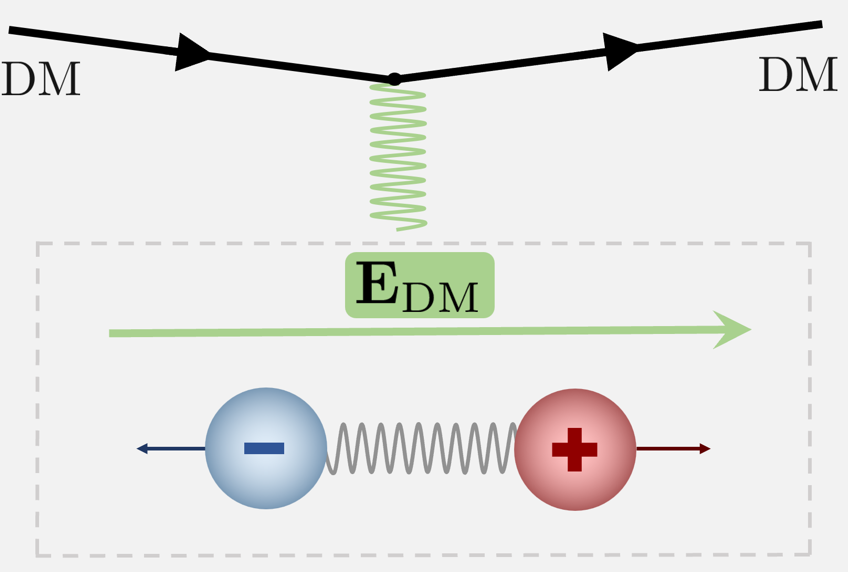
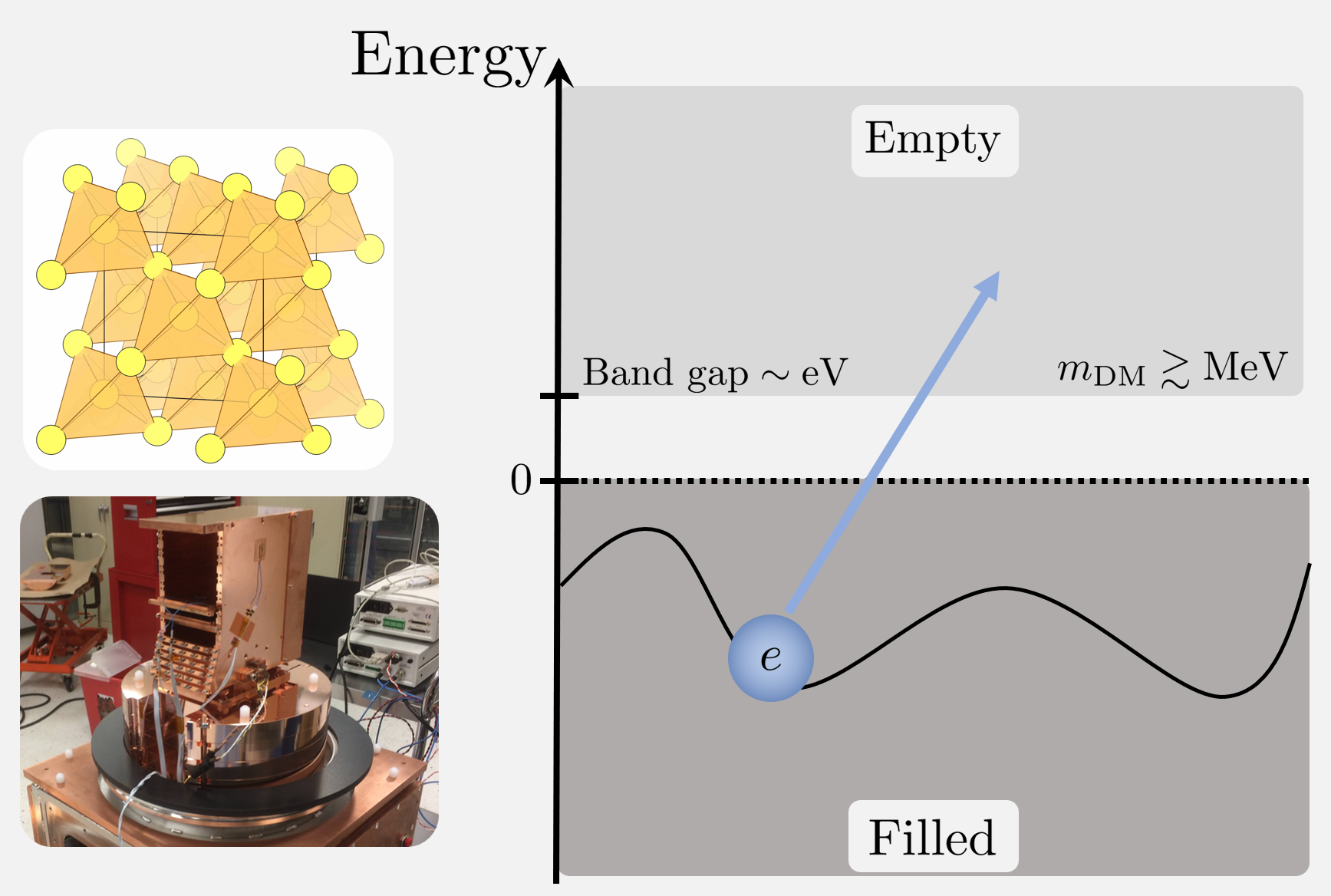
Electron excitation-based direct detection experiments are at the forefront of the search for MeV-GeV mass light dark matter. My work provides precise theoretical predictions for dark matter-electron interaction rates in these experiments. Using non-relativistic effective field theories, I also explore the broader phenomenology of dark matter-electron interactions, helping to interpret current results and guide future experiments.
Selected Publications
The Next Generation of Direct Detection
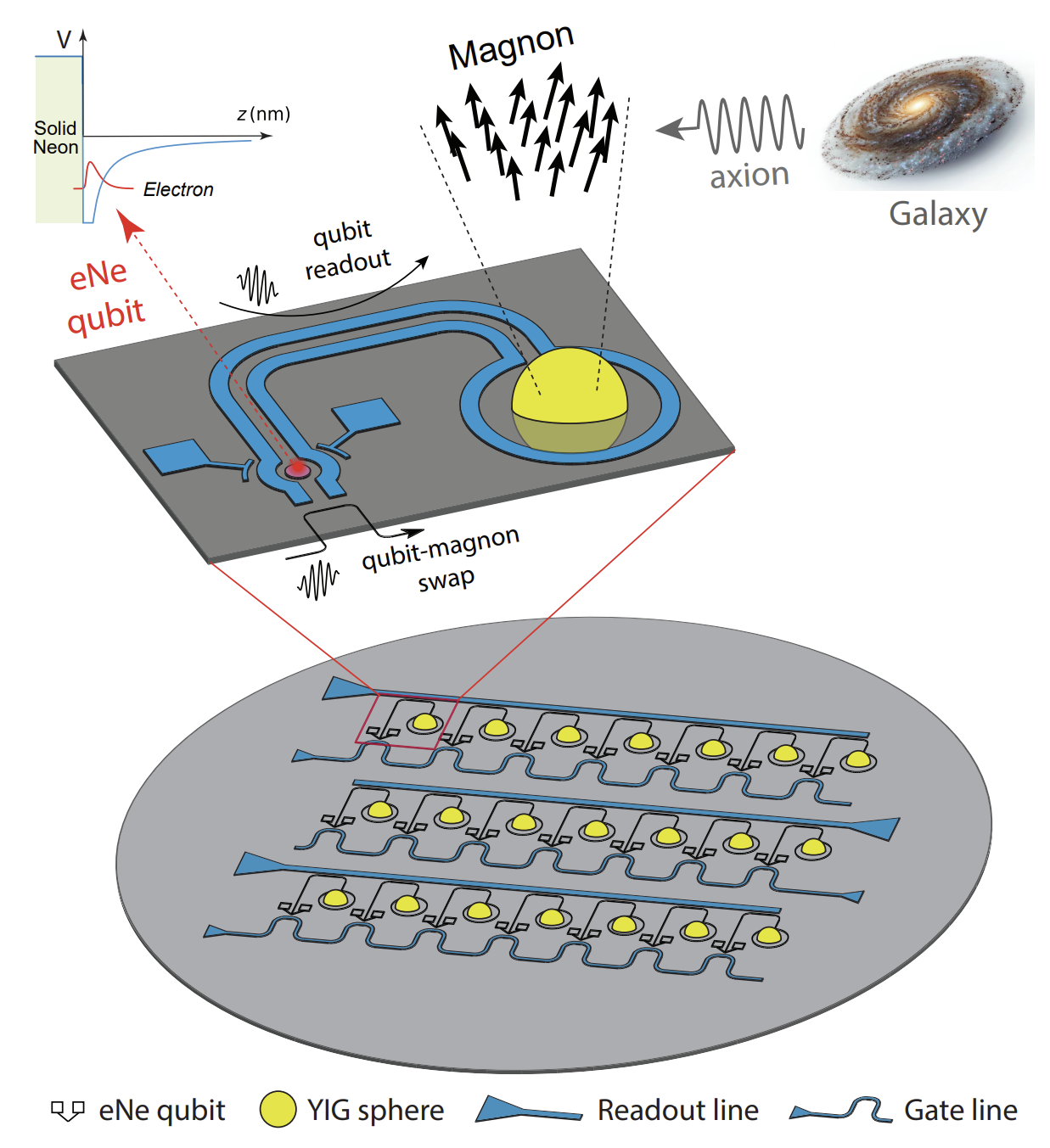
The next generation of direct detection experiments must have lower, meV-scale, thresholds to search down to keV mass fermionic dark matter. Collective excitations, such as phonons and magnons, naturally have meV-scale excitation energies and are therefore promising target excitations. My research explores how dark matter interacts with collective excitations, and how experimental ideas from quantum sensing can be used to aid in their detection.
Selected Publications
New Technologies To Search For Axions and Dark Photons
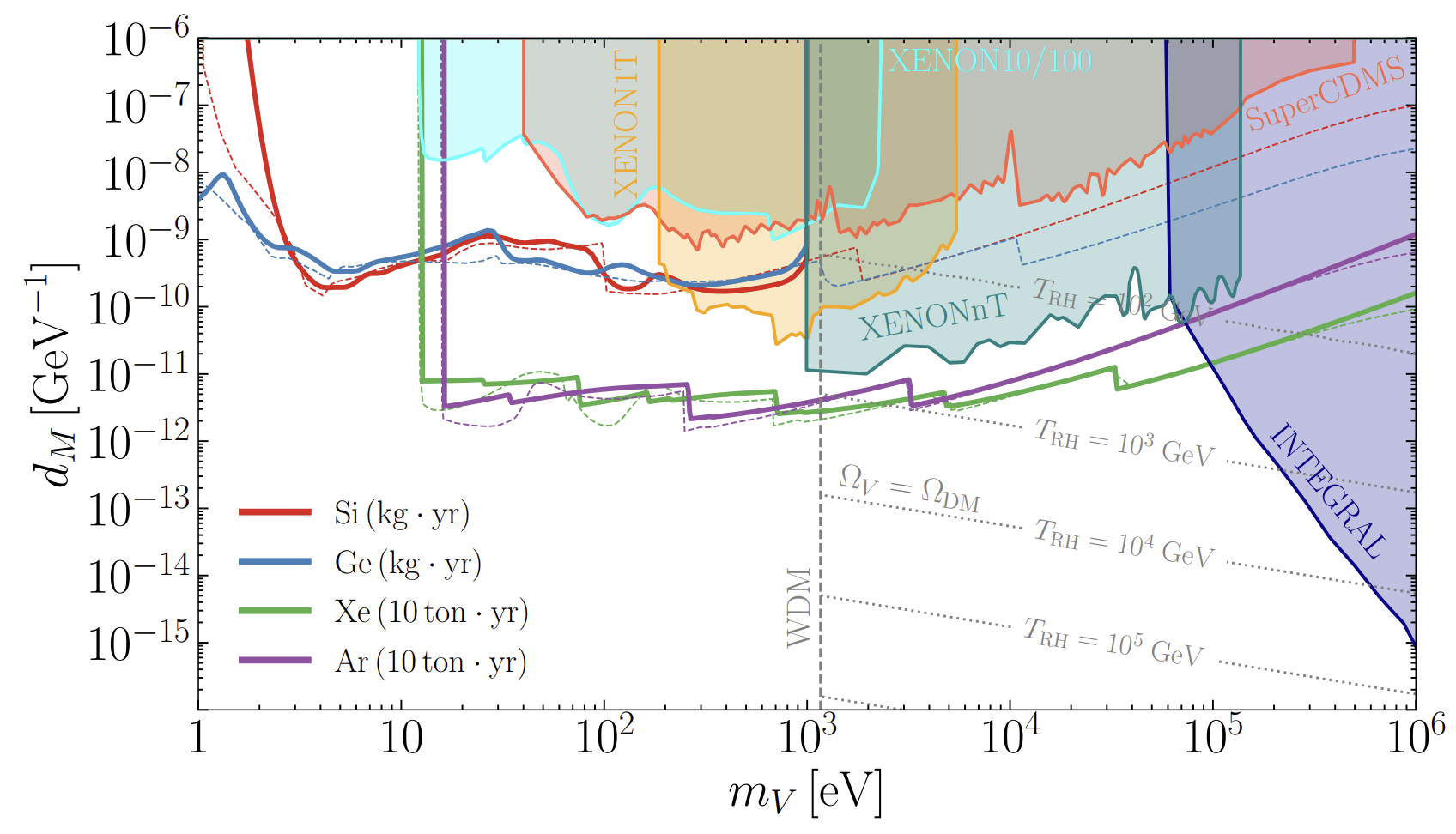
Ultralight bosons, with masses below an eV, are some of the most theoretically well-motivated DM candidates. From QCD axions and axion-like particles, to dark photons which couple to charge or baryon number, there are a wide range of compelling ultralight bosonic dark matter candidates. This wide range of candidates has a similarly vast phenomenology, requiring the development of diverse technologies to pursue detection. My research searches for axions and dark photons beyond the reach of current experiments through novel applications of current technology and the design of new detectors.
Selected Publications
Novel Benchmark Targets For Light Dark Matter
Recent results from the DAMIC collaboration, using electronic excitations in silicon targets, have begun to rule out theoretically well-motivated dark matter candidates at MeV-GeV masses. While parameter space for the simplest light dark matter models is still available at sub-MeV masses, out of the reach of electron-based direct detection, now is the time to consider the next-to-simplest models that can be searched for with the next generation of experiments. My research focuses on finding cosmologically viable dark matter models with novel low-energy phenomenology.
Selected Publications
Leveraging Pulsar Timing Arrays To Search For Dark Matter
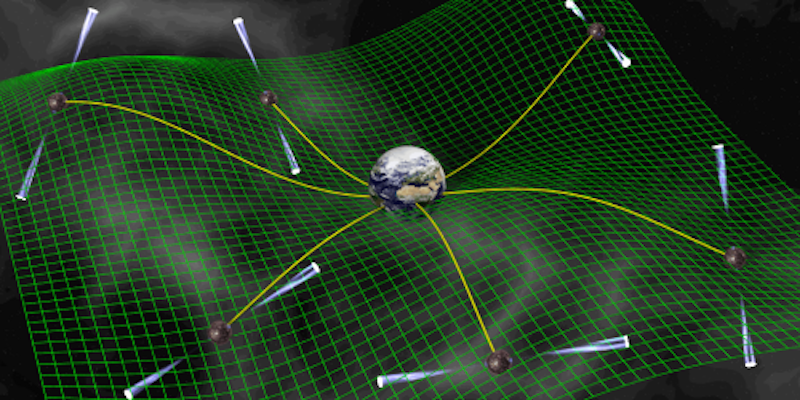
The search for dark matter requires creating new detection technologies, and leveraging the sensitivity of experiments that are in operation today. My research seeks to understand how pulsar timing arrays can be used to search for dark matter and our expand our understanding of the universe before recombination. I am an associate member of the North American Nanohertz Gravitational Wave Observatory (NANOGrav), and use this membership to search for new physics signatures directly inside the newest datasets.
Selected Publications
Dark Matter Experiments To Search For High-Frequency Gravitational Waves
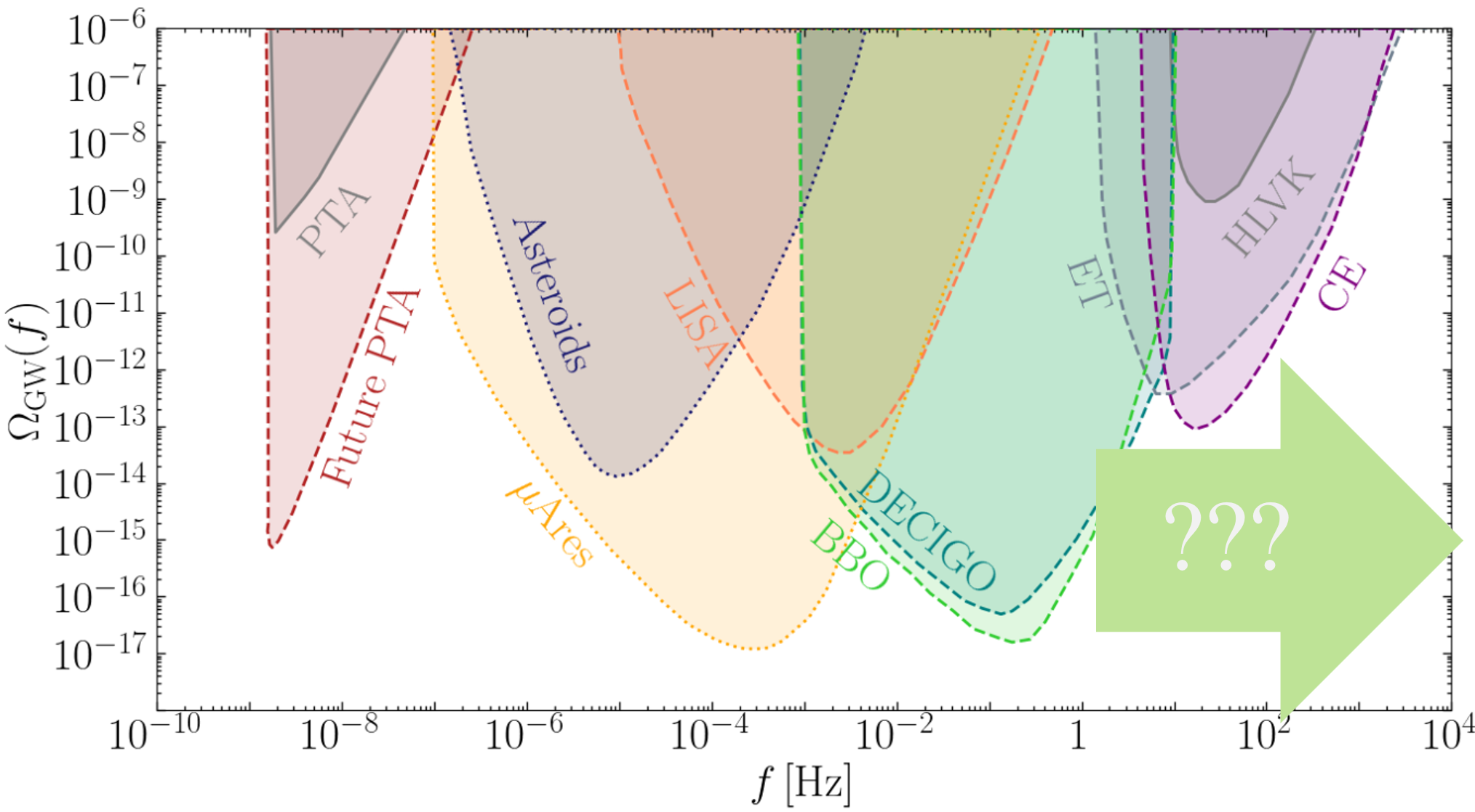
While space-based interferometers and pulsar timing arrays are poised to revolutionize the exploration of gravitational waves at low frequencies, the search for gravitational waves above a kHz remains a relatively unexplored frontier. My research is interested in understanding how other direct detection experiments can be leveraged to search for high-frequency gravitational waves, as well as understanding if there are well-motivated beyond the Standard Model sources of these high-frequency gravitational waves.
Selected Publications